

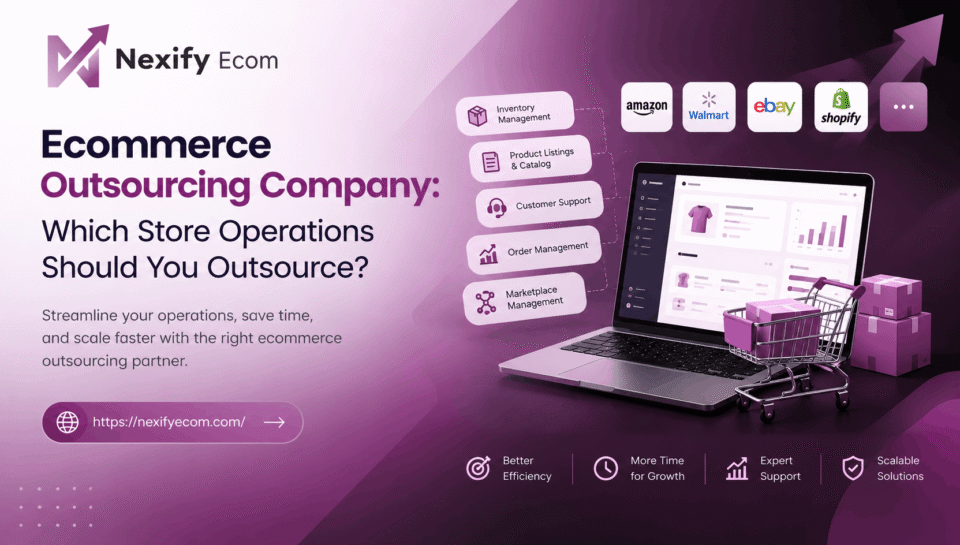
Ecommerce Outsourcing Company: Which Store Operations Should You Outsource?
Discover how to choose an ecommerce outsourcing company by identifying tasks to delegate, comparing outsourcing with in-house teams, and evaluating service costs, expertise, and deliverables. Learn how ecommerce outsourcing services can streamline product listings, inventory coordination, order management, customer support, and marketplace operations across Amazon, Walmart, Shopify, Etsy, and eBay. Use these practical steps to identify operational gaps, select the right support, and build a scalable ecommerce workflow with solutions from Nexify Ecom.
What Is an Ecommerce Outsourcing Company?
An ecommerce outsourcing company provides external support for the tasks required to operate and grow an online business. Depending on the agreement, its responsibilities may include store management, product catalog maintenance, order coordination, customer support, and marketplace operations.
For example, a seller managing multiple marketplaces may struggle to update product listings, monitor inventory, and coordinate daily orders. Outsourcing selected responsibilities allows the business owner to delegate those tasks while maintaining control over business decisions.
An outsourcing partner may provide individual specialists or a team responsible for agreed deliverables. The right arrangement depends on your store size, sales channels, operational workload, and growth objectives.
Businesses can also combine professional management with suitable technology. To understand the difference, explore our guide to ecommerce automation agency services.
Which Ecommerce Operations Should You Outsource?
Not every task needs to be outsourced. Start by identifying repetitive activities, operational bottlenecks, and responsibilities that require specialized knowledge.
1. Ecommerce Store Management Services
Managing an online store requires consistent attention to product information, account performance, inventory, and operational tasks. As the catalog expands, these responsibilities can become increasingly time-consuming.
Professional ecommerce store management services can help businesses organize daily workflows, maintain listings, monitor performance, and coordinate store activities.
For example, Amazon sellers may need ongoing support with listing optimization, inventory planning, and account monitoring. Our Amazon FBA Management Service explains how specialized management can support these operational requirements.
2. Product Listings and Catalog Management
Product listings influence how customers discover and evaluate products. Inaccurate information, incomplete descriptions, and inconsistent product data can create unnecessary problems across sales channels.
Outsourced listing support may include:
Creating and updating product listings.
Optimizing titles, descriptions, and product attributes.
Maintaining consistent catalog information.
Reviewing product images and listing content.
Identifying opportunities to improve listing quality.
Businesses selling across multiple marketplaces should also consider each platform’s listing requirements and policies. Professional support can help maintain organized catalogs while leaving final product and brand decisions with the business owner.
3. Inventory and Order Management
Inventory and order coordination become more complex as order volume and the number of sales channels increase. Stock discrepancies, delayed updates, and missed operational tasks can affect the customer experience.
An outsourcing partner may assist with inventory monitoring, order tracking, supplier communication, and fulfillment coordination. Suitable systems can also help synchronize inventory information and reduce repetitive administrative work.
The exact responsibilities depend on the business model. For example, Amazon FBA and merchant-fulfilled operations have different fulfillment workflows. Sellers should establish clear responsibilities for stock planning, shipping coordination, and exception handling before outsourcing these activities.
4. Customer Support and Daily Store Operations
Customer inquiries, order-related questions, returns, and routine account tasks can take time away from strategic work.
Ecommerce support services may help businesses organize customer communications, monitor service requests, maintain records, and coordinate issue resolution. Before delegating customer support, define response-time expectations, escalation procedures, and the types of decisions the external team can make independently.
Businesses should also establish appropriate access permissions and protect customer information when working with external providers.
5. Marketplace Management Across Multiple Platforms
Selling across Amazon, Walmart, Shopify, Etsy, or eBay introduces different operational requirements. Each platform has its own listing standards, account processes, and performance considerations.
An experienced partner can help coordinate these responsibilities according to the agreed service scope.
Explore Nexify Ecom’s ecommerce services to review available platform-specific solutions, including Amazon, Walmart, Shopify, Etsy, and eBay-related services.
What Ecommerce Outsourcing Services Do Companies Offer?
The services offered by an ecommerce outsourcing agency vary according to its expertise and the client’s needs. Common options include operational management, marketplace support, catalog maintenance, and specialized consulting.
Ecommerce Management and Operational Support
Ecommerce management services may cover recurring tasks such as listing maintenance, inventory monitoring, order coordination, and performance reporting. A clearly defined scope helps businesses understand which activities are included and which remain their responsibility.
Ecommerce Automation Services
Some operational tasks can be supported by automation, such as inventory synchronization, order notifications, and repetitive data updates. However, automation and outsourcing are not the same.
Outsourcing delegates work to an external team, while automation uses systems or software to execute defined workflows. Many businesses benefit from combining both approaches, with people overseeing exceptions and strategic decisions.
Ecommerce Growth and Strategy Support
Operational improvements can create more time for marketing, product development, and business planning. Depending on the provider, ecommerce growth services may include performance analysis, listing optimization, marketplace expansion support, and strategic recommendations.
For businesses needing specialist assistance with Amazon operations, Amazon Virtual Assistant Services for Amazon Sellers provides another relevant resource.
Ecommerce Outsourcing Company vs. In-House Team
Both outsourcing and in-house hiring can support an ecommerce business. The right choice depends on workload, budget, required expertise, and the level of direct control needed.
An in-house team offers closer day-to-day collaboration and may be suitable when a business needs dedicated employees for continuous responsibilities. However, recruitment, training, payroll, and employee management require resources.
Outsourcing provides access to external expertise without necessarily building a full internal department. It can be useful when specific tasks require specialist support or when workload changes throughout the year.
Consider these factors before deciding:
Cost: Compare total employment costs with outsourcing fees and any additional software expenses.
Expertise: Evaluate the provider’s experience with your specific marketplace and business model.
Control: Decide which decisions must remain internal and which tasks can be delegated.
Flexibility: Assess whether the arrangement can accommodate changes in workload.
Accountability: Agree on deliverables, reporting frequency, and performance expectations.
The best solution may be a hybrid model in which internal staff handle strategy while an external team supports daily execution.
When Should You Hire an Ecommerce Outsourcing Agency?
Outsourcing becomes worth considering when operational responsibilities start limiting your ability to manage the business effectively.
You may benefit from external support when:
Daily store tasks leave little time for business planning.
Managing multiple marketplaces creates operational complexity.
Your team lacks specific marketplace expertise.
Listing updates and routine processes are frequently delayed.
You need additional support without immediately expanding your internal team.
Before hiring, document your current workflow and identify the tasks consuming the most time. This makes it easier to choose appropriate ecommerce outsourcing services and evaluate whether the arrangement addresses your actual needs.
How to Choose the Right Ecommerce Outsourcing Company
Choosing a provider requires more than comparing service packages. The right partner should understand your marketplace requirements, business objectives, and operational challenges.
Check relevant experience. Look for experience with your sales channels, product categories, and required tasks.
Define the service scope. Confirm which activities are included, who approves important decisions, and how exceptions will be handled.
Review communication and reporting. Establish reporting frequency, communication channels, and escalation procedures.
Understand pricing. Ask whether fees are fixed, hourly, project-based, or recurring. Clarify additional charges and any minimum contract period.
Evaluate security and access. Use appropriate account permissions, confidentiality agreements, and documented procedures for sensitive business information.
Set measurable expectations. Agree on practical indicators such as listing completion, response times, inventory accuracy, and task turnaround. Sales and profitability also depend on factors beyond the outsourcing provider’s control.
A reliable ecommerce management provider should be transparent about its responsibilities, limitations, and reporting process.
How Ecommerce Outsourcing Supports Business Growth
Outsourcing does not guarantee higher sales, but it can help businesses organize operations and direct resources toward higher-priority activities.
Delegating routine tasks may free up time for product research, marketing, customer experience improvements, and expansion planning. Access to specialized support can also help businesses address operational gaps without developing every capability internally.
As a store grows, review the arrangement regularly. Track service quality, operational consistency, costs, and business priorities to determine whether the outsourced scope should change.
Why Choose Nexify Ecom for Ecommerce Management and Support?
Nexify Ecom provides ecommerce solutions across supported marketplaces, with services covering store operations, automation, management, and growth-related support.
Businesses can explore the Nexify Ecom Services page to review available solutions and identify services relevant to their operational needs. Our About Us page also explains our approach to building and managing structured ecommerce operations.
Whether you need specialized marketplace assistance or support coordinating recurring store activities, start by identifying your business priorities and the tasks you want to delegate.
Ready to identify the right support for your online store? Book a Free Strategy Call with Nexify Ecom to discuss your goals and explore suitable service options.
Frequently Asked Questions
What does an ecommerce outsourcing company do?
An ecommerce outsourcing company handles selected online business tasks for clients. Depending on the agreement, these may include store management, product listings, inventory coordination, order support, and marketplace operations.
Which ecommerce tasks can businesses outsource?
Businesses can outsource product catalog maintenance, listing optimization, inventory monitoring, customer support, order coordination, and other recurring tasks, depending on their needs and the provider’s capabilities.
How much do ecommerce outsourcing services cost?
Costs depend on the service scope, workload, number of marketplaces, required expertise, and contract structure. Request a detailed proposal that specifies deliverables, additional charges, and ongoing support.
Is outsourcing suitable for small ecommerce businesses?
Yes. Small businesses may outsource selected tasks when hiring a full-time employee is unnecessary or when they need expertise they do not have internally. The decision should reflect the available budget and expected value.
What is the difference between ecommerce outsourcing and automation?
Outsourcing involves delegating work to an external team. Automation uses technology to execute predefined tasks. Businesses can combine both, using automation for suitable repetitive workflows and human oversight for decisions, exceptions, and strategy.